WorldSkills 2026 in Shanghai

Kip is supporting Team Germany's painters at the WorldSkills Competition.

Tim Schäfer und das Maler Team Germany treffen sich gemeinsam mit Kip-Anwendungstechnikern in Bocholt zur Vorbereitung auf die WorldSkills 2026.
Tim Schäfer (front row, second from the left) and the Maler Team Germany met with Kip application engineers in Bocholt to prepare for WorldSkills 2026.

From September 22 to 27, 2026, the best young skilled workers from around the world will gather at WorldSkills in Shanghai. The event is considered the World Championship of the Trades. Representing Germany in the painting and finishing discipline will be Tim Schäfer from Hesse. As the official sponsor of Maler Team Germany, Kip is already supporting the contestant and his team at a preparatory meeting at the company’s headquarters in Bocholt.

Table of Contents

WorldSkills is the official world championship for non-academic trades. Every two years, the best young skilled workers from numerous countries compete against one another and demonstrate their skills in disciplines such as painting and finishing, tiling, carpentry, mechatronics, and many other fields. The competition’s roots date back to the early 1950s.

How WorldSkills Came About as a Result of the Skilled Labor Shortage

In the 1950s, Europe suffered from a massive shortage of skilled workers. World War II had decimated an entire generation of skilled workers. Many craftsmen, journeymen, and master craftsmen had been killed in action, seriously wounded, or were still being held as prisoners of war. At the same time, destroyed cities, transportation routes, and industrial facilities had to be rebuilt. The demand for well-trained skilled workers was correspondingly high.

In the face of this shortage of skilled tradespeople, the goal was to inspire young people to pursue trades such as painting, masonry, carpentry, or electrical work. The idea came from the Spaniard Francisco Albert-Vidal: motivation through competition. Under the auspices of the International Vocational Training Organization (IVTO), he launched the first international skills competition in Madrid in 1950, with Spain and Portugal participating initially. The goals were clear: to help young people recognize the value of skilled trades, to foster their ambition through competition, and to instill a new sense of pride in the trades.

The vocational skills competition is going multinational

The concept proved successful and quickly gained prominence beyond Spain’s borders. Just three years later, other countries—including Germany, France, Switzerland, Morocco, and the United Kingdom—took part in the first multinational competition. At that time, the German team still traveled to Spain by minibus across the Pyrenees.

1953 marked an important milestone: Representatives from the participating countries met in Madrid and decided to establish an international organization to coordinate global vocational competitions. For many years, the competition was known as the “International Vocational Training Competitions (IVTC)” before it was renamed in 2000 to its now globally recognized name, the “WorldSkills Competition.”

WorldSkills: An Olympic-Style Atmosphere for the Skilled Trades

Today, WorldSkills is regarded as the world championship of vocational skills and takes place every two years at rotating host cities. At WorldSkills 2026 in Shanghai, around 1,400 young skilled workers from more than 70 countries will come together to compete for gold, silver, and bronze in 64 disciplines. The competition is reminiscent of the Olympic Games: National teams compete in their national colors, national anthems are played, and fans cheer on the participants. In addition, opening and closing ceremonies in large arenas create a true World Cup atmosphere.

How is the competition for painters and finishers conducted?

WorldSkills is a four-day competition that pushes the contestants to their mental and physical limits. In the Painting and Finishing discipline, they must demonstrate their technical skills in various tasks under competitive conditions. The jury evaluates every step of the process and every result according to set criteria. Each task has a tight time limit, which is displayed via a digital countdown.

In addition, the conditions in the competition arena make it difficult for the competitors to concentrate: spectators, machine noise, concurrent competitions, and camera crews all add to the stress. Nevertheless, the participants must perform at their best and execute every move with precision.

A Level Playing Field for All Competitors

Proper preparation for the competition is essential. This includes having your own toolbox, which every participant must bring. However, cheating is not an option, as the international jury inspects the toolbox before the competition for unauthorized aids such as digital color meters or pre-made stencils. In addition, all participants are assigned their own workstation. It serves as the center of the competition, is set up identically for all competitors, and consists of several walls and a door to be worked on.

What are the tasks in the competition?

The Maler Team Germany is preparing at Kip for WorldSkills 2026 in Shanghai.The competition organizers do not reveal the final details of the tasks until shortly before the competition begins. As a result, the contestants cannot prepare specifically for individual tasks but must master the entire spectrum of the painting and finishing trade.

The World Championship tasks are divided into various modules:

  1. Surface Preparation and Painting: This is where the fundamental skills of the craft are put to the test. Participants must transform a raw surface into a uniform, high-quality finish through sanding, filling, priming, and painting. The jury pays close attention to even the smallest imperfections, such as dust particles trapped in the paint or drips—that is, visible paint runs caused by paint flowing unevenly.
  2. Color Matching: In the color matching challenge, participants must demonstrate their eye for color and their intuition. They are given a specified color shade, which they must reproduce exclusively by mixing primary colors. Technical aids are not permitted. The jury then evaluates the dried color, and even the slightest deviations in brightness or saturation can result in point deductions.
  3. Wallpapering: For this task, candidates must wallpaper a complex wall surface with inside and outside corners. They use intricate patterned wallpaper that reveals even the smallest mistakes. The pattern must align perfectly at the seams, while the transitions should be as invisible as possible. In addition, no air bubbles or paste residue should be visible. Clean and precisely cut edges complete the look.
  4. Design and Layout: Here, participants transfer a given graphic design onto a wall. To do this, they enlarge the motif to scale, trace it, and mask off the individual areas. When applying the paint, they must work with particular precision so that, in the end, only clean and sharply defined paint edges remain.
  5. The Speed Competition: The painters must precisely apply a given shape to the wall within a very tight time frame. The key is to work flawlessly even under intense time pressure and achieve clean, sharp paint edges.
  6. Freestyle: In this module, the painters apply a design technique of their own choosing—one that is as challenging as possible—to a separate wall. Here, they use various techniques, such as glazing or marbling, to showcase their own artistic style. The jury evaluates the execution, aesthetics, harmony, neatness, and the level of difficulty of the chosen technique.
Here's how the scoring system works at the World Cup

The jury evaluates the entries using a two-part system to prevent national bias. First, there is the objective evaluation, which considers only visible criteria. The judges answer questions with “yes” or “no,” such as whether a wallpaper seam is closed, a paint edge is clean, or a design is aligned with the specified position.

In addition, there is a subjective evaluation in which the experts assess the overall impression. A tidy worksite, efficient use of materials, and the safe handling of tools are also factored into this evaluation.

Team Germany – Who Makes Up the National Team of Painters?

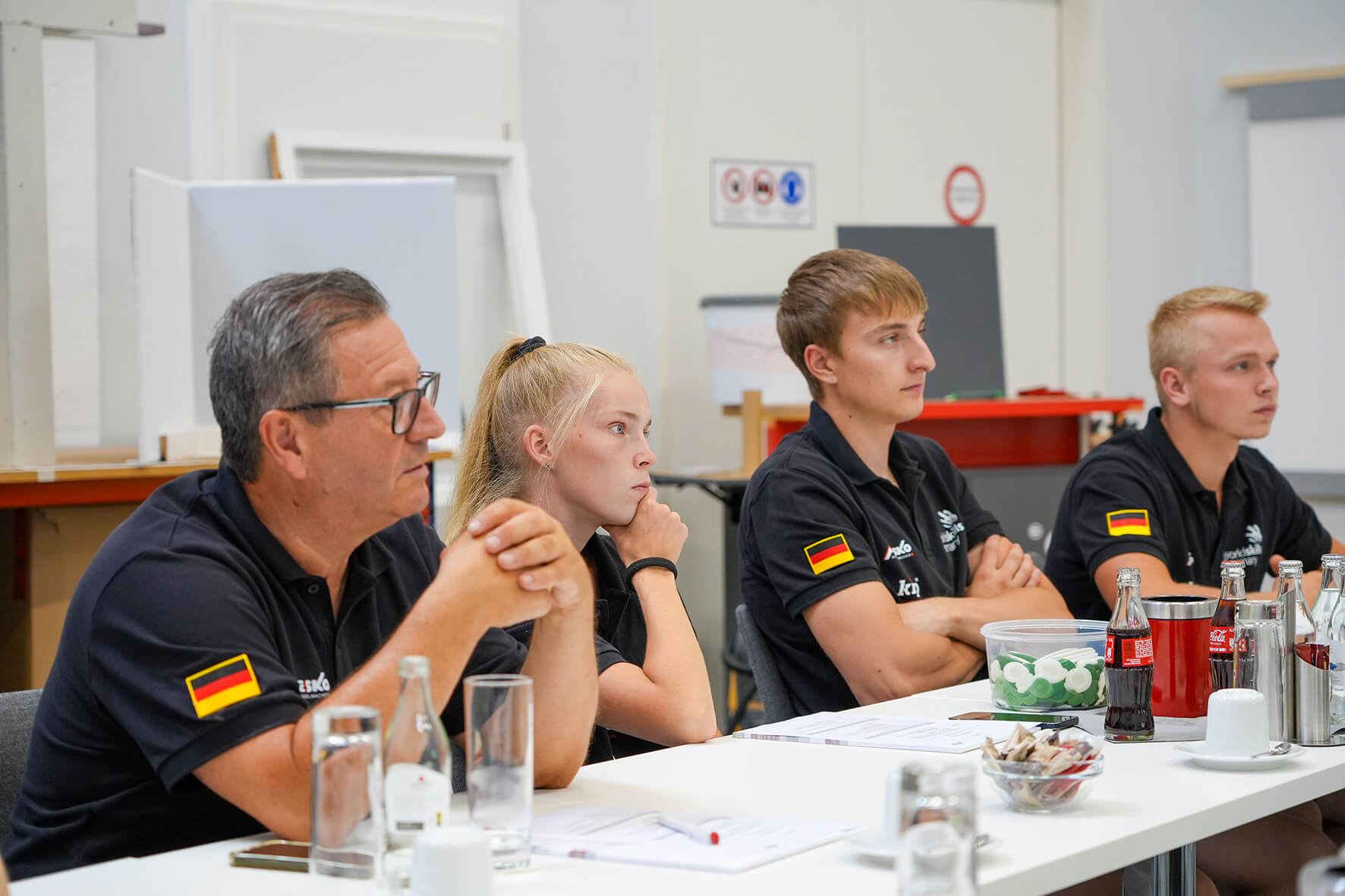
Bundestrainer Diego Gomez-Velazquez sowie Penelopé Comita, Tim Schäfer und Jonas Schneegans bei der Vorbereitung des Maler Team Germany auf die WorldSkills 2026.
From left to right: National Team Coach Diego Gomez-Velazquez, Penelopé Comita, Tim Schäfer, and Jonas Schneegans.

To be selected for the national team, candidates must first prove themselves in a national selection competition. This competition is the final hurdle before WorldSkills. Here, Germany’s best up-and-coming painters compete against one another for the sole spot on Team Germany.

For the painting and finishing discipline, the Federal Association for Paint, Design, and Building Protection (Bundesverband Farbe Gestaltung Bautenschutz) and WorldSkills Germany work closely together. The selection competition is modeled as closely as possible on the conditions of the international WorldSkills Championship—from the tasks and judging criteria to the competitive pressure. Only those who succeed here are allowed to represent Germany at WorldSkills.

However, the team consists not only of the actual competitor but also of a strong support team behind the scenes. Coaches, experts, and supporters ensure professional preparation and stand by the competitor, offering advice and assistance.

Let’s take a closer look at the Painting Team Germany.

The Face of the Team: Tim Schäfer Right Up Front

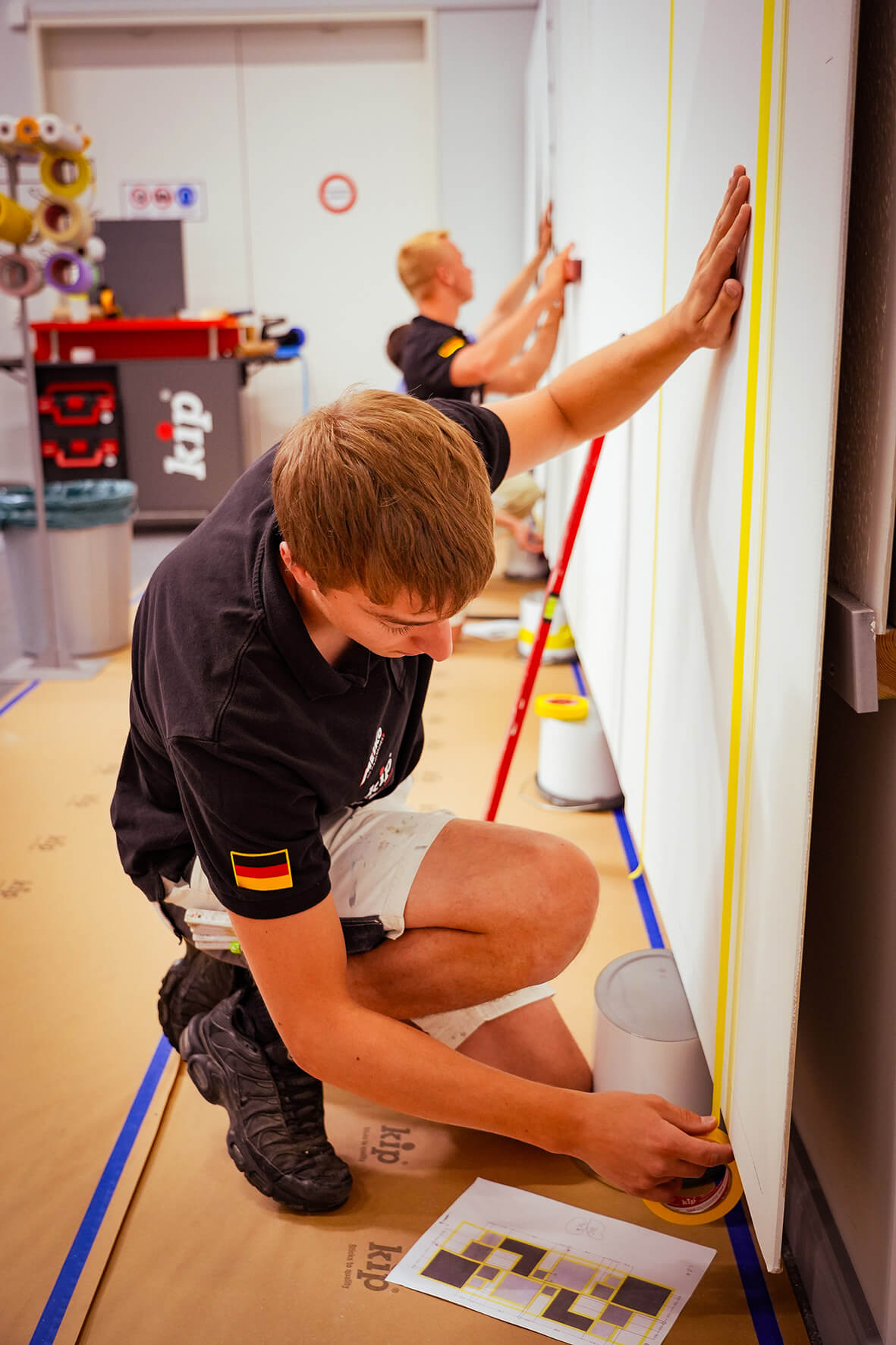
Tim Schäfer bonding Kip® tape to a wall.At the heart of the national painting team is Tim Schäfer from Hofbieber in Hesse (see photo). The reigning state champion prevailed over Jonas Schneegans and Penelopé Comita at the national selection competition in Weiterstadt, thereby securing his spot at WorldSkills 2026 in Shanghai.

Schäfer is already considered one of Hesse’s top up-and-coming painters and is preparing intensively for the WorldSkills Competition. Leading up to the competition, he trains regularly and attends training camps alongside Schneegans and Comita to perfect and further develop his craft. The trio forms the expanded painting team and supports one another as they prepare for WorldSkills 2026.

The Coach: National Team Coach Diego Gomez-Velazquez

Experienced national team coach Diego Gomez-Velazquez plays a key role in preparing Maler Team Germany for the WorldSkills Competition. As an official WorldSkills expert, he is familiar with the international rules and regulations, analyzes the jury’s evaluation criteria, and tailors his team’s training specifically to meet those criteria.

In addition, Gomez-Velazquez works with the participants to hone their technical skills. Numerous training sessions focus on topics such as tool handling, workflows, and time management. Mental preparation for the competition is just as important. Drawing on his experience, he supports Tim Schäfer and the entire team on their journey to WorldSkills 2026 in Shanghai.

Heroes Behind the Scenes: The Support Network

Behind the Maler Team Germany stands a strong network of supporters, without which a national team could not function. This includes associations at the regional and national levels that provide the team with organizational and financial support. In addition, there are foundations and industry partners that invest in the training, continuing education, and professional equipment of the participants, thereby creating optimal conditions for the WorldSkills Competition.

The training or employing company also plays a major role in this success. Preparing for the WorldSkills Competition is time-consuming and requires a great deal of support. That is why the company must stand behind its candidate and make it possible for them to participate in training camps, press events, and other activities. Only this support makes targeted preparation for WorldSkills possible and demonstrates the employer’s confidence in its young talent.

Kip is a proud sponsor of the national painting team

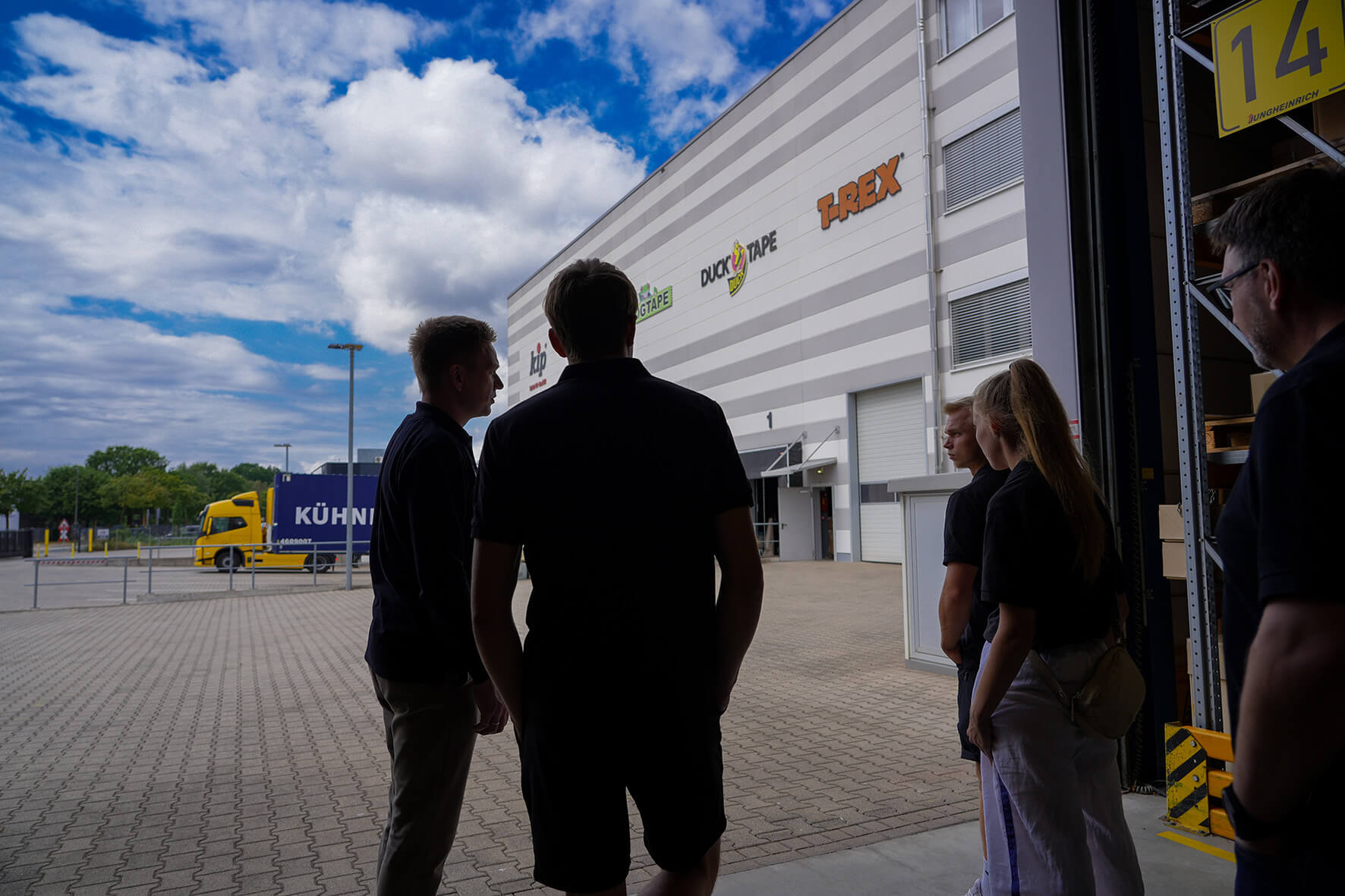
Das Maler Team Germany und Vertreter von Kip betrachten während eines Rundgangs über das Firmengelände in Bocholt den Außenbereich des Unternehmens vom Eingang einer Lagerhalle aus.
During a tour of Kip's company grounds in Bocholt, the Maler Team Germany gained insight into the company.

It was with great pleasure that we welcomed Tim Schäfer, along with his training partners and the coaching staff, to the Kip headquarters in Bocholt on July 27 and 28. Over the course of two intensive days, the focus was on professional exchange, practical applications, and targeted competition preparation for WorldSkills 2026. Special emphasis was placed on the speed competition, which could be intensively practiced at our facility under realistic conditions.

Together, we tested various tape solutions and discussed their potential applications in training and competition. At WorldSkills in particular, precision, speed, and reliable materials play a crucial role. We were therefore all the more pleased to support Tim Schäfer and the Maler Team Germany in their preparations with our expertise—honed over decades—and Kip® tapes.

For Kip, supporting top-tier young talent goes far beyond traditional sponsorship. Supporting young talent means investing in the future of the painting trade. A spirit of innovation, passion, and technical excellence are essential prerequisites for the industry’s continued development. That is why we are supporting Tim Schäfer and the Maler Team Germany on their journey to the WorldSkills Competition in Shanghai and are happy to do our part to promote the next generation of skilled tradespeople.

We would like to thank Tim Schäfer and the entire Team Germany for two exciting days filled with professional exchange. We are particularly pleased that our adhesive tape solutions will continue to support the team at WorldSkills 2026 in Shanghai. We wish Tim Schäfer and the entire team the best of luck for the final weeks of preparation and for the WorldSkills Competition.

Frequently Asked Questions About WorldSkills

Where will WorldSkills 2028 take place?

The next WorldSkills competition following Shanghai 2026 will take place from November 15 to 20, 2028, in Aichi, Japan. The 49th WorldSkills Competition will be held at the Aichi International Exhibition Center (Aichi Sky Expo). The decision to host the event in Aichi was made at the WorldSkills International General Assembly in Lyon in September 2024. Approximately 1,700 participants from more than 65 countries and regions are expected to attend the event.

How can you apply for WorldSkills?

It is not possible to apply directly to WorldSkills. Participants must first qualify through national and regional competitions in their respective occupational disciplines. In Germany, selection takes place through competitions and tryouts organized by WorldSkills Germany and the relevant trade associations. Those who prevail against the national competition there earn the opportunity to represent Germany at WorldSkills. The participants are then specifically prepared for the WorldSkills competition.

Do you prefer personal advice?

Simply enter your details in our callback form and one of our service employees will call you back within 24 hours.

Alternatively, you can reach us by telephone or e-mail using the contact details below.

We look forward to getting to know you and your future project!