Efficient and safe masking
There are no compromises when it comes to careful covering and masking. But what is important to protect substrates efficiently and cover them safely?
Stress with customers is inevitable when material splashes and paint marks spoil the joy of freshly painted work. What’s more, the surfaces to be protected are often more sensitive these days. As a result, more and better cover is usually required.
The requirements for tapes and masking materials vary depending on the nature of the substrate, the intended use and the duration of the masking. This is the occasion to discuss current issues relating to professional masking and covering with branded products with the adhesive tape manufacturer Kip from Bocholt.
Portfolio: How can I recognize a tape that is suitable for professional use?
Alexander Naroska: One indicator of a professional tape is definitely the use of high-quality materials – such as modern Washi tapes with a thin, stable backing and high-performance acrylic adhesive. They enable precise color edges and hold reliably even under demanding conditions. However, the real difference in the professional sector lies not only in the product, but also in the selection: A professional recognizes which tape is technically appropriate for which substrate, which duration of use and which load. It is precisely this understanding that makes the difference between “well taped” and “perfectly taped”.

Folder: How do I find the right tape for my masking job at Kip?
A. Naroska: At Kip, the selection process is systematic: the starting point is always the requirements of the application – i.e. duration of use, substrate, load and place of use indoors or outdoors. This determines which tape is the right technical solution – whether Masking-Tec®, Smooth-Tec® or WASHI-TEC®. With our complete crepe system, we provide clear guidance that leads the user step by step to the right tape. In addition, our product catalog and our field service consultants provide support in finding the optimum solution for every application.
Folder: How do I carry out a test gluing?
A. Naroska: A test application is always recommended! It demonstrates safety by making it clear whether the tape is suitable for the substrate. During the test application, a tape with a stronger adhesive strength than the tape actually intended is applied to the substrate to be protected. To do this, a tape of approx. 10 cm in length is pressed down firmly and torn off with a jerk. If there is no tearing damage to the substrate, the weaker adhesive tape can be used. If the substrate cannot be assessed with certainty, e.g. if there are signs of weathering, a test bond should be carried out over a longer period of at least 24 hours before the final bond is applied. In this way, the adhesive-specific properties such as the increasing force increase of the adhesive can be estimated more reliably. In addition to the general test bonding, it is advisable to carry out further substrate-specific tests depending on the substrate.
Folder: Which application errors lead to damage to substrates?
A. Naroska: Normally, an incorrect substrate assessment and the wrong choice of adhesive tape usually lead to damage. For example, tapes are used in practice that were actually developed for a completely different application.
Folder: Removing tapes: How do I do it right and at what time?
A. Naroska: Tapes should be removed carefully and evenly. The removal angle should be as flat as possible. When removing paper adhesive tapes, make sure that the paint has only dried but is not completely dry, otherwise the backing may tear off and leave residue on the substrate.
Folder: Adhesive residue after removing tapes: How do I remove residue from critical substrates?
A. Naroska: If adhesive residue does occur, it is advisable to use a cleaner suitable for the substrate in question. Professional cleaning manufacturers offer suitable solutions for this. It is important to always test the cleaner yourself on an inconspicuous area, as different reactions can occur depending on the substrate and its ageing. The technical data sheets and manufacturer’s instructions must always be observed.
Portfolio: Which products from your portfolio are of particular interest to painters and plasterers and why?
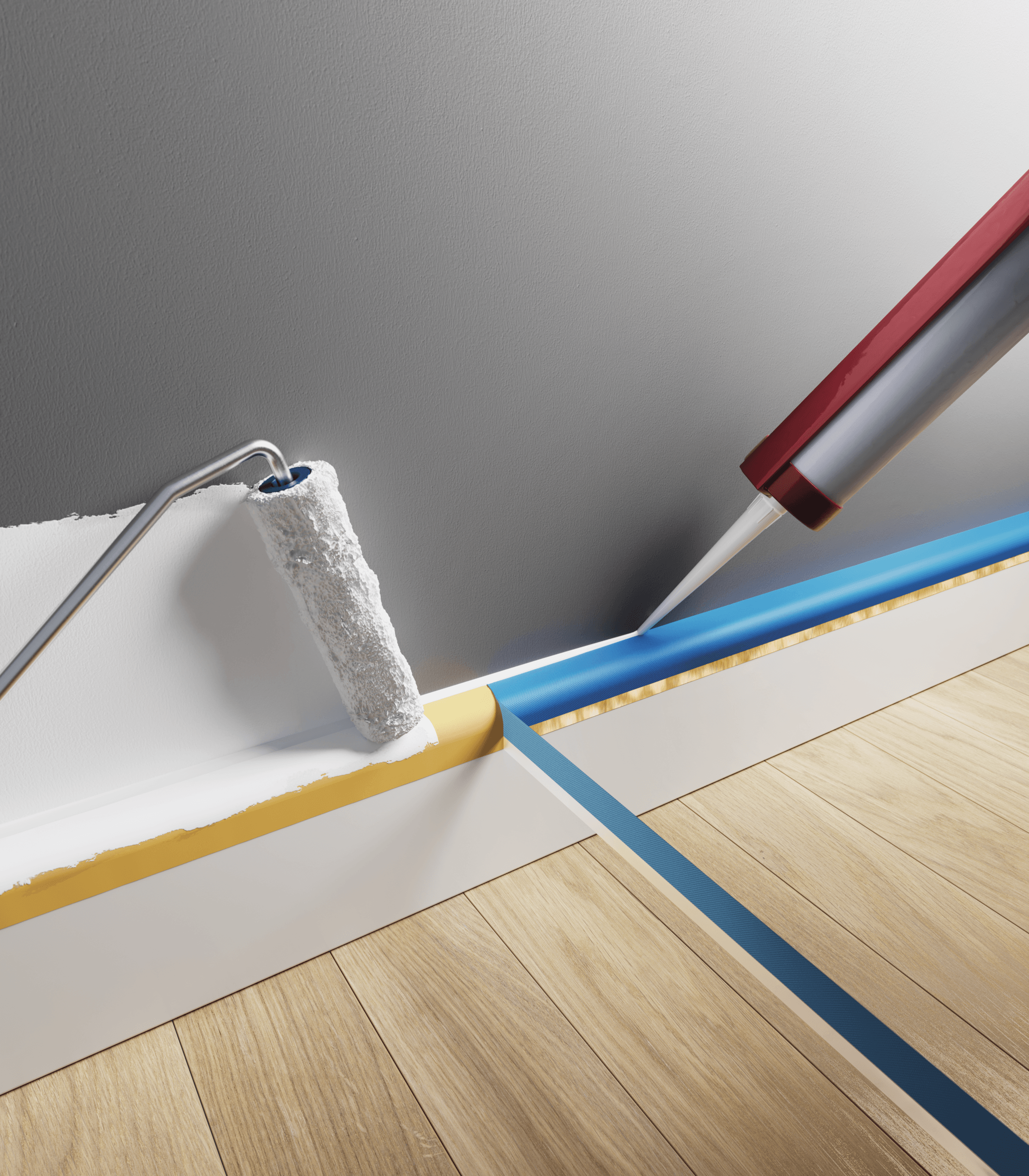
A. Naroska: Our Original Multi-Tape is a special product because it solves a very specific practical problem. Many painters and plasterers are familiar with the situation: surfaces have to be taped several times – first for one work step, then again for the next. This is time-consuming, sometimes nerve-wracking and also harbors the potential for errors. This is exactly where our Multi-Tape comes in. We have developed a system that combines the advantages of robust Duct tapes with the precision of Washi tape. This allows several work steps to be carried out more efficiently without having to constantly re-mask. The result is a solution that not only saves time, but also provides clean color edges and reliable protection – exactly what really counts in everyday work.
Mappe: Thank you very much for your advice and tips for perfect masking.
Source: The Artists’ Magazine *Mappe*, May 2026 [abridged version]