Which Tape for Which Surface? A Practical Guide for Professionals
Learn what matters most when choosing the right tape.

Not all tapes are the same. Depending on the project you’re working on and the nature of the surface you’re bonding it to, you’ll need different types of tapes. It’s important that the tape you choose is exactly right for your intended use. Tapes that work perfectly on glass aren’t automatically the right choice for fresh plaster, wood, or plastic.
But how do you choose the right tape for a specific application? A look at the most important selection criteria will help you find the right solution for every application.
Which Tape for What? Four Criteria for Choosing
Choosing the right tape depends primarily on the substrate, the duration of use, the type of application, and the environmental conditions.
Substrates:
What substrate will you be bonding to? Check whether the tape adheres and whether the surface has sufficient adhesion. You should also consider the nature of the substrate, as smooth, rough, or textured surfaces behave differently.
Duration of use:
How long should the tape remain in place before and after application?
Application:
What is the tape’s intended purpose? Whether for clean and precise paint edges when painting, to protect surfaces during coating work, or to distribute mechanical stress during plastering: The planned application has a significant influence on choosing the right tape.
Environmental Factors:
In what environment and under what external conditions will the tape be used to bond? Temperature, sunlight, UV exposure, and weather conditions all affect adhesion. You should take these environmental factors into account when selecting the appropriate tape.
What are the key factors in bonding?
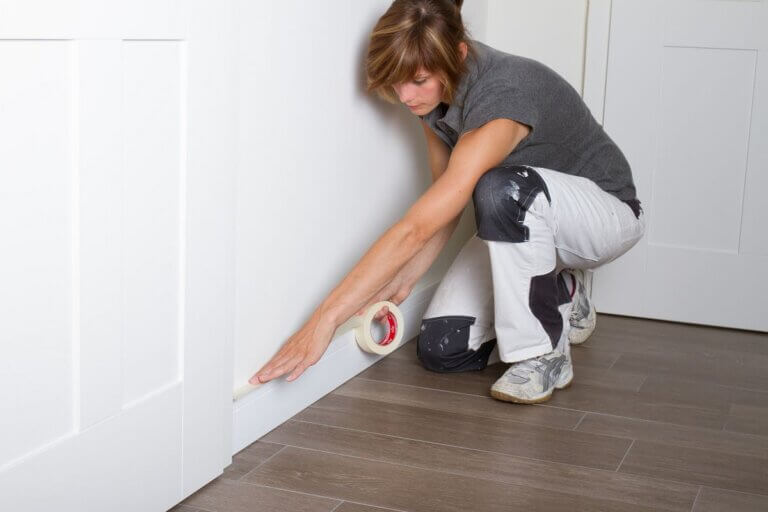
The first step is to inspect the surface to be bonded. It should always be clean—that is, free of dust and grease and dry—to ensure the best possible surface for bonding.
The Correct Processing Temperature
Be mindful of the temperature when removing the tape
Ambient temperature also plays a role that should not be underestimated when removing tape. The temperature should not be too low. The optimal temperature is above 5 °C; otherwise, the tape may be more difficult to remove and adhesive residue may be more likely to remain.
Specialty Adhesive Tapes for Extreme Temperatures
If tapes need to be bonded at an ambient temperature or substrate temperature of less than 5 °C or more than 40 °C, a special tape is recommended. These special tapes—for example, those with acrylic adhesives—are higher in terms of temperature resistance and are therefore suitable for use under these conditions.
Assessing the Substrate: How to Avoid Damage During Demolition
Since there are a large number of possible combinations, the interactions between the adhesive, the substrate, and environmental conditions are very complex. In cases where the adhesive strength of the tape exceeds the bond strength of the substrate, tearing damage may occur when the tape is removed. To prevent this, you should always assess the substrate and test its bond strength before bonding the tape.
Test Methods for Evaluating Adhesion Strength
There are four methods for assessing the adhesion strength of a surface.
Visual inspection:
A visual inspection checks the general condition of the substrate for obvious defects. To do this, examine the surface under adequate lighting, paying close attention to moisture, cracks, contaminants, and adhesive residue. This assessment will tell you whether the surface is even suitable for bonding or whether you need to perform any preparatory work.
Wipe test:
The wipe test checks the surface cleanliness of the substrate and whether it bleeds, chalks, or is dusty. To do this, run your hand or a cloth over the surface with light pressure. If dirt remains, it will impair the tape’s adhesion, and you should clean the surface beforehand.
Scratch test:
The scratch test checks the hardness and load-bearing capacity of the substrate. To do this, scratch the surface in a crisscross pattern with a hard object. If plaster crumbles, paint peels off, or a deep scratch forms, the surface is unstable and should be stabilized beforehand.
Adhesive Tape Test/Test Bonding:
The test bonding method has proven to be very effective in practice. With this method, you apply a piece of tape with a higher adhesive strength than the tape you plan to use later to the desired surface. To do this, use a strip of adhesive tape that should be about 10 cm long and press it firmly onto the surface. Then pull the strip off the surface in one quick motion. If there is no visible damage from the removal, you can use the weaker tape to bond the final piece.
For surfaces that you cannot assess with certainty—for example, due to weathering—it makes sense to perform a longer test bond period of at least 24 hours before the final bond. If the substrate shows signs of damage from peeling after the extended test, you should use a tape with a gentler adhesive strength.
Which surface requires which type of tape?

Depending on the surface, different requirements apply when bonding. The following guidelines will help you choose the right tape for glass, wood, plastic, metal, natural stone, plaster, and other surfaces.
What kind of tape is suitable for glass surfaces?
Glass is considered a smooth surface and generally does not pose any special challenges for the adhesion of tapes. However, this changes, especially in the summer, when the bond is exposed to direct sunlight. This can be the case, for example, with tapes applied to the inside of window panes. The glass pane can cause high temperatures and intense UV exposure. This can shorten the tape’s service life and make it more difficult to remove later.
In summer heat, you should use tapes with UV-resistant acrylic adhesive. Acrylic adhesives are characterized by high resistance to temperature and aging, and reliably maintain their adhesive properties even after prolonged exposure to sunlight.
Suitable Kip® adhesive tapes with high-quality acrylic adhesive include: WASHI-TEC® Gold masking tape Premium Plus (3308) and WASHI-TEC® Gold masking tape Premium (3808).
What kind of tape should I use on wood?
For use on wood, we recommend the Kip® DUCT-TEC® Unico (372) tape, the Premium Plus PVC protective tape (315), and the Premium Plus PVC protective tape with cross-grooves (318).
Once the work is complete, peel off the tape slowly and at a shallow angle. This reduces the risk of wood fibers or coatings being pulled off with the tape.
If the bond must withstand additional mechanical stress—such as from a covering film that exerts extra tension on the bond—double masking may be advisable. To do this, first apply a tape with gentle adhesion and then reinforce it with a tape that has stronger adhesion, such as PVC protective tape.
Which type of tape sticks to plastic?
Tapes that are resistant to plasticizers are ideal for plastic surfaces, provided they remain on the substrate for as short a time as possible. For weathered plastics, a test application is also recommended.
When working with plastics, you should distinguish between new and weathered substrates. Weathered plastics in particular are considered critical substrates, as aging and weathering processes can make the surface brittle or porous and compromise its strength.
In addition, in rare cases, an interaction between the tape and the plastic may occur. Discoloration of the substrate is possible due to a phenomenon known as plasticizer migration. Therefore, we recommend masking plastic surfaces only for short periods. Our plasticizer-resistant PE protective tape Kip® 319 or the Kip® DUCT-TEC® Unico (372) are particularly suitable for such applications.
With weathered plastics, there is also a risk that the aged surface layer will peel off when the tape is removed. This can result in color differences. For this reason, you should always perform a test bond before bonding the plastics.
Tape on Metal: What Should You Keep in Mind?
Metal surfaces such as zinc, titanium-zinc, or copper require special attention. If the surface is covered with protective measures (e.g., films), condensation may form under certain conditions. This creates a risk of corrosion. To prevent this, you should mask the surface for a short term or cover the entire surface.
When using protective films, make sure to bond them with as few air bubbles as possible. Moisture can collect beneath air bubbles, which promotes the corrosion mentioned above.
In addition, metal surfaces are subject to natural oxidation and aging. If individual areas are masked off for an extended period, these processes may proceed more slowly in those areas. After removing the tape, visual differences may become apparent between the masked areas and those that were exposed to the elements. Depending on the type of metal, these differences often take some time to even out. You should generally expect this to take a few months.
When selecting tape , also take into account the expected surface temperatures, especially in direct sunlight. Metals can get very hot! For metal surfaces, WASHI-TEC® Gold masking tape Premium Plus (3308) or WASHI-TEC® Gold masking tape Premium (3808), for example, are suitable due to their high UV and Temperature resistance.
For bonding zinc, we recommend our Kip® PVC Protective Tape Premium Plus (315).
What kind of tape sticks to natural stone?
Natural stone is one of the most challenging substrates for bonding. Therefore, we do not recommend applying adhesive tape to natural stone. Instead, use non-adhesive materials to cover the surface.
Experience has shown that discoloration can occur around the tape on natural stone even after a short period of bonding. Despite their name, cloth tapes known as “cloth tapes” are not suitable for natural stone or open-pored substrates, but rather for surfaces such as concrete or plaster.
For covering natural stone, we recommend non-adhesive materials such as our vapor-permeable masking papers Kip® 331 and Kip® 336. If additional securing is necessary, these can be fastened with individual strips of adhesive tape. However, be careful not to apply the tape in direct contact with the natural stone.
Which tape should I use for rough-textured and smooth plaster surfaces?
For plaster surfaces, the structure of the substrate is the most important factor. For rough and textured plasters, we recommend tapes with higher adhesive strength that conform well to the unevenness of the substrate. The Kip® 326 cloth tape is particularly well-suited for this purpose, as it connects high adhesive strength with very supple flexibility.
On smooth surfaces or plaster, however, you can use tapes with lower tack. The choice of backing depends on the intended application. For creating distinct color boundaries or multi-layer coatings, we recommend the Fineline-Tape Kip® 380 cloth tape, as it allows for particularly sharp color edges and can be removed cleanly thanks to its sturdy backing.
How to Mask Coatings and Paints Safely
Before masking off coatings or paints, you should ensure that their adhesion to the substrate is greater than the adhesive strength of the tape you are using. Otherwise, damage such as peeling or discoloration may occur when the tape is removed. To determine the appropriate tape, it is advisable to perform a test application beforehand.
Also, make sure that paints have fully evaporated and cured before masking them partially or over the entire surface. Otherwise, discoloration or paint peeling may occur.
For sensitive coatings, products such as WASHI-TEC® Delicate (309) or WASHI-TEC® Delicate Soft (375) are suitable due to their particularly gentle adhesive strength.
Which type of tape should I use for wallpaper and other wall coverings?
Wallpaper, paper surfaces, and textile wall coverings are among the most delicate surfaces. To prevent damage during removal, you should use tapes with the lowest possible adhesive strength.
Especially on older, poorly adhering, or repeatedly painted-over wallpaper, we recommend conducting a test application before proceeding. This will help you determine whether the wall covering might peel off when the tape is later removed.
For such applications, Kip® 309 WASHI-TEC® Delicate is a good choice; it was specifically developed for demanding painting projects on delicate surfaces. For sturdy wallpaper and other well-adhering wall surfaces, our Kip® 3508 SMOOTH-TEC® Smooth masking tape is a good choice.
At a Glance: The Right Tape for Every Surface
| Substrate | What to Look For | Recommended Products |
|---|---|---|
| Glass | When exposed to direct sunlight, use UV- and temperature-resistant tapes with acrylate adhesive. | WASHI-TEC® Gold masking tape Premium Plus (3308) WASHI-TEC® Gold masking tape Premium (3808) |
| Wood | After completing the work, peel off the tape slowly and at a shallow angle. | DUCT-TEC® Unico (372) PVC Protective Tape Premium Plus (315) PVC Protective Tape Premium Plus, cross-grooved (318) |
| Plastic | Consider weathering and potential plasticizer migration. A test bond is recommended. | PE Protective Tape (319) DUCT-TEC® Unico (372) |
| metal | Be aware of corrosion risks, natural aging, and high surface temperatures. | WASHI-TEC® Gold masking tape Premium Plus (3308) WASHI-TEC® Gold masking tape Premium (3808) PVC Protective Tape Premium Plus (315) |
| Natural Stone | Do not mask natural stone. Instead, cover it with non-adhesive materials. | Masking papers (331) Masking papers (336) |
| Plaster | Adjust the adhesive strength to the surface texture. | Cloth tape (326) Fineline-Tape cloth (380) |
| Coatings & Paints | Perform a test bond; allow the paints to fully evaporate and cure. | WASHI-TEC® Delicate (309) WASHI-TEC® Delicate Soft (375) |
| Wallpaper & Wall Coverings | Use tapes with low tack. | WASHI-TEC® Delicate (309) SMOOTH-TEC® Smooth masking tape (3508) |
Frequently Asked Questions
When should a test bond be performed?
A test application is always recommended if you cannot reliably assess the adhesion strength of the surface or if you have doubts about whether you can remove the tape without leaving any residue. Testing is especially advisable for delicate, weathered, coated, or surfaces that have already been painted over multiple times.
To do this, apply the intended tape to an inconspicuous area and remove it after a reasonable amount of time. This will allow you to determine early on whether the bond holds reliably or whether damage such as tears, peeling, or discoloration occurs on the surface.
Why doesn't my tape stick to plastic?
Tapes often adhere less well to plastic if the surface is dirty, weathered, or altered by plasticizers. Older plastic surfaces, in particular, can become brittle over time or change their surface properties, causing the tape’s adhesion to diminish.
Therefore, first check whether the surface is clean, dry, and free of dust, grease, or other residues. Also, use a tape suitable for plastic surfaces, and perform a test application on critical or weathered surfaces.
What kind of tape sticks to aluminum?
On aluminum and other metal surfaces, UV- and temperature-resistant adhesive tapes with acrylate adhesive are particularly effective. Metal surfaces can become very hot, especially when exposed to direct sunlight, which is why the tape’s temperature resistance plays an important role.
For use on aluminum surfaces, we recommend Kip® 3308 WASHI-TEC® Gold masking tape Premium Plus and Kip® 3808 WASHI-TEC® Gold masking tape Premium.
How do I remove tape from plaster?
Remove tape from plaster as slowly as possible and at a shallow angle. Avoid sudden movements, as this may cause plaster particles or coatings to come loose from the surface.
How do I remove adhesive tape residue from glass?
Remove adhesive residue from glass as soon as possible using warm water and a soft cloth. If the residue cannot be completely removed, you can use a suitable adhesive remover or glass cleaner. Under no circumstances should you use sharp or pointed tools, as these can scratch the glass surface.
At what temperature should tape be applied?
For most tapes, the optimal application temperature ranges from 5 °C to 40 °C. To achieve optimal adhesion, the tape rolls should ideally be at a temperature between 15 °C and 30 °C before use. At lower or higher temperatures, special tapes may be required.